Replacement Mop Pads — Any Fabric, Size or Attachment, Made to Order
Can you make a replacement pad for our mop head?
Yes. We produce replacement pads to order in every construction we run — cut-pile microfibre, looped terry, chenille and tassel, knit with clip-in pockets, hook-and-loop faces and anti-odour treated fabric. Send the old pad, the bare head, or a drawing with length and width, and we match the fabric, the grammage and the attachment.

Our own shelf display: six different pad constructions on hang cards, colour-coded, ready for a retail aisle. The pad is the part of a spray mop that gets thrown away first — which is why it is the SKU with the repeat order attached.
How do I request a replacement-pad quote?
Email the mop model, head dimensions or an underside photo, the pad or wipe type, your order quantity and pieces per pack. i-smiler can quote pads separately from the mop.
Email us for a pad or wipe quote
Which pad constructions do you produce?
Six families, all cut to a head rather than to a model name: cut-pile microfibre, looped terry, chenille and tassel (the shaggy, high-trapping kinds), knit fabric with clip-in pockets, and hook-and-loop faces on a woven backing.
| Construction | How it behaves on the floor | Typical use |
|---|---|---|
| Cut-pile microfibre | Dense short pile, picks up fine dust and dries quickly | Standard retail refill for hard floors |
| Looped terry | Towel-loop face, high water holding, cheap to launder | Budget refills, multi-pack |
| Chenille / tassel | Long yarn strands reach into grout and tile joints | Textured floors, deep-clean positioning |
| Knit with clip-in pockets | A bound slot through the centre, or pockets at the corners, pulls the pad onto the frame; nothing is sewn to the head | Pads that the consumer replaces by hand |
| Hook-and-loop face | Pad sticks to a plastic plate; the plate stays on the mop and the pad comes off for the wash | Flat mops, wall and surface mops |
| Anti-odour treated | Zinc-pyrithione finish on the fabric, for pads that sit damp between uses | UK and EU retail programmes; treatment spec sheet on request |

Same pad shape and same chenille fringe, a different face panel — which is the normal way a refill programme branches: one head, several faces, several price points on the same shelf slot.
Base plates and pad-plus-plate assemblies that clip onto a swivel head are supplied on the same programme.

Three faces and three footprints on one table: a chenille pad with grey chevron yarn and a central clip slot, a looped terry pad, and a narrow knit pad of the size used on hand and surface heads. Different fabric, different price, same cutting and sewing operation — which is why a refill range is built from one programme rather than one SKU.

The looped terry face on its own: a pale centre panel between two darker borders, all four sides bound. This is the row the table above calls the budget refill — a towel-loop face that holds water and launders cheaply.
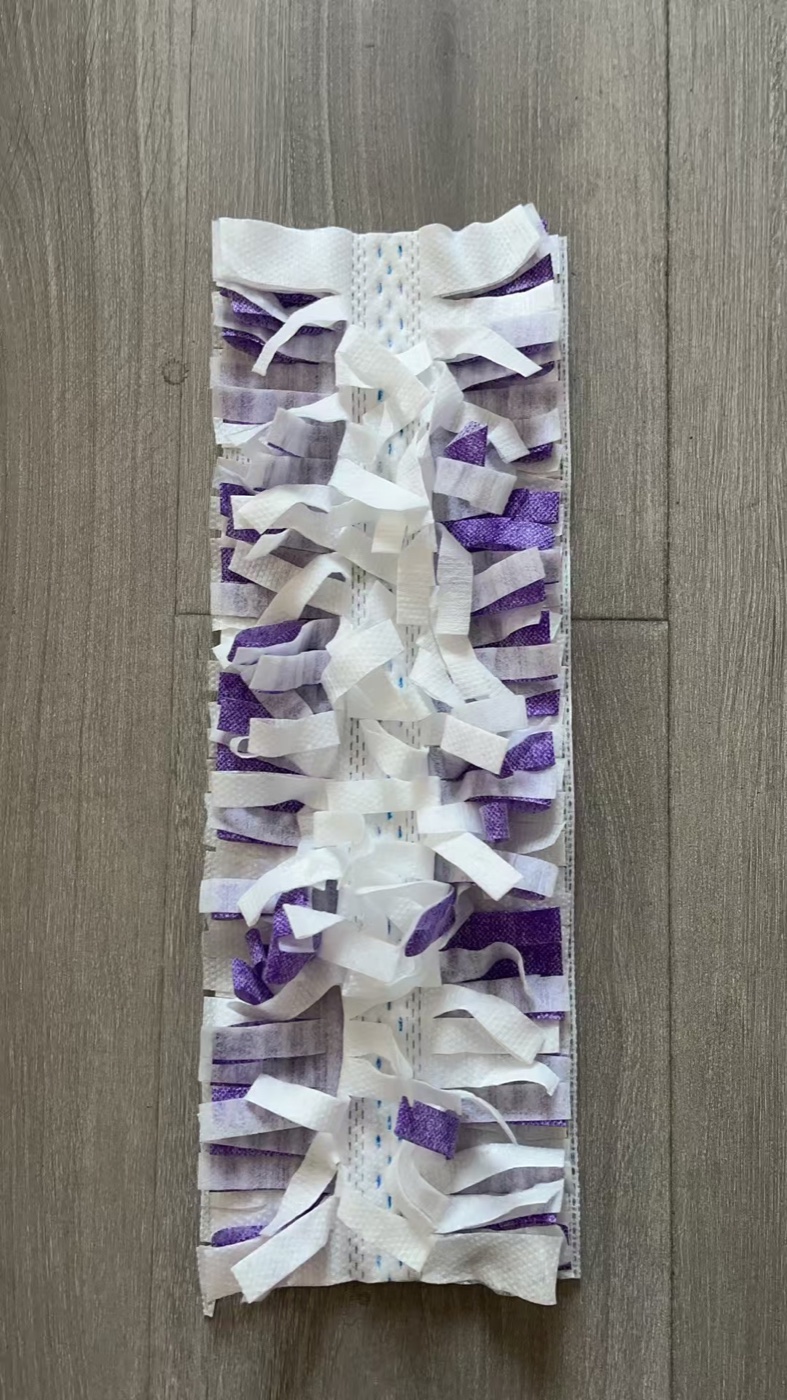
Disposable mop pad compatible with Swiffer PowerMop
i-smiler has fitted the pictured white-and-purple disposable replacement pad on a Swiffer PowerMop head. The pad has a strip-style cleaning face. For a production order, request a sample to check fit on the head you plan to use.
What sizes do you keep as standard?
Three sizes run as standard — 39.5 × 12 cm, 41.5 × 14 cm and 24.5 × 14.5 cm — and anything outside them is cut to your drawing, which is the normal route for a custom head. On a measured production sample our large pad ran 392 × 122 mm at 34.8 g with a five-needle edge stitch.
| Size | Fits | Packing options |
|---|---|---|
| 39.5 × 12 cm | Standard spray-mop and flat-mop heads | Bulk polybag or shelf-ready hang card |
| 41.5 × 14 cm | Wider spray-mop and flat-mop heads | Bulk polybag or shelf-ready hang card |
| 24.5 × 14.5 cm | Small heads, hand and surface mops | Bulk polybag or shelf-ready hang card |
| Cut to your drawing | Any head we have not seen before | As your programme requires |

Photographed flat, so the edge is the dimension: an overlocked border runs continuously around rounded corners and the pile sits inside it. When a buyer specifies a size, this finished edge is the rectangle that gets cut.
How do replacement pads attach to the head?
Four ways, and the attachment is what decides whether a refill actually fits: hook-and-loop, a bound central slot or corner pockets that the head pushes into, an elastic or woven skirt clipped around the plate, or a pad sewn to a plate that clicks into a swivel head.


Top: a knitted pad shown face and back — the coloured yarn rows are the pile, and the opening is bound so it cannot run. Bottom: a chenille/tassel pad, where the fringe does the scrubbing in grout lines and the centre panel keeps the pad dimensionally stable.


Three states of the same idea. First: the nose of the head pushed into a red-bound slot in a knitted pad, with a blue looped terry pad beside it — nothing is glued or sewn to the head, and the pad comes off with one hand for the wash. Second: a chenille pad lying face-up with the clip engaged in its central opening. Third: the same pad with the slot open and nothing in it, which is what the opening looks like before anyone has tried to fit anything. This is the one field a drawing cannot carry, which is why we ask for a photo of the back of the head rather than a model number: two pads with the same outline can behave differently on the same head if the opening is not in the same place.
What should we send to specify a custom pad?
Five fields, in this order, and we can quote from them without a call: pad length × width in millimetres, fabric and grammage or a target weight in grams, the attachment type (hook-and-loop, pocket, tab or skirt) with a photo of the back of the head, colour or colour-code plan, and packing (bulk polybag, hang card, or your retail box).
- Size — length × width, flat, in mm, plus the tolerance you will accept.
- Fabric — construction (cut-pile / terry / chenille / tassel / knit) and target weight per pad in grams, or grammage in g/m².
- Attachment — hook-and-loop, a bound central slot, corner pockets, or a clip-on skirt; a photo of the back of the head settles it.
- Colour — one colour, or a zone-coded set (we run blue, grey, red, green, yellow, purple).
- Packing — bulk polybag, shelf-ready hang card with your artwork, or a boxed multi-pack.
A physical sample is better than any of the above: we reverse-engineer the fabric and the stitching and send a counter-sample before you commit to a tooling-free order.

Two pads that differ mainly in trim — the knitted one bound in purple, the chenille one bound in navy on a two-tone blue pile. Fabric, binding colour and pile colour are three separate lines on one spec sheet, and each can be moved without touching the others.
What is measurable about a pad before you order?
Pad weight and size, edge stitch density, shrinkage after laundering, absorbency and colour fastness are all figures we can put on a purchase order and inspect against. Weight and shrinkage are the two that separate a refill that sells once from one that sells monthly.
| What you can specify | Our working limit | Measured on a production sample |
|---|---|---|
| Pad size | ≥ 370 × 115 mm on the large pad | 392 × 122 mm |
| Pad weight | ≥ 28 g | 34.8 g, five-needle edge stitch |
| Shrinkage, 3 washes at 40 °C | ≤ 5 % | −0.5 % length, −0.8 % width, no seam loss |
| Absorbency | > two-thirds of mop weight | Met |
| Colour fastness to water | Grade ≥ 3 (GB 18401-2010) | Grade 4–5, colour change and staining |
| Fabric chemistry | REACH Annex XVII and AfPS GS restricted substances | 14 items on mop fabrics, all PASS (report CTT2603060500ENR1) |
The weight, size, shrinkage and absorbency lines come from a pre-shipment sample tested under a customer's programme, so the underlying report is not republished here; the colour-fastness and fabric-chemistry reports are issued in i-smiler's own name and are listed with verifiable numbers on the verification page.
How can I check fit on my mop head?
Send the mop model and a photo of the underside of the head, plus the dimensions of the original pad. A head or pad sample lets us check the attachment and prepare a counter-sample for your approval.
For a flat mop that grips a disposable wipe, see the SMN1000 auto-clip flat mop.
How are pads ordered, packed and re-ordered?
MOQ is 3,000 pieces per pad type. Pads ship shelf-ready on a printed hang card with your artwork, in bulk polybag for a multi-pack or a club store, or as a pad-plus-plate assembly. Pads are ordered on their own as well as with mops — that is what makes a refill worth a shelf position.
Lead time follows the standard 35-day term from order to shipment; a new pad shape or a new colour runs with the next production slot. Six zone colours are stocked, and one fabric can be sold as six SKUs by colour alone.


Top: the same terry fabric dyed six ways — grey bound to match, blue bound in lime, yellow, red, green and purple behind them. Colour is decided at the dye bath, so one fabric can carry six shelf positions. Bottom: our own hang-card refill on our own display rail — hook slot at the top, three floor finishes along the bottom, four lines of copy between them. Your artwork replaces ours.
FAQ
What is the MOQ for replacement mop pads?
3,000 pieces per pad type. Trial quantities below that are considered case by case for qualified buyers, usually as a pad-plus-mop mixed order.
Can we order pads only, without mops?
Yes. Replacement pads ship on their own, not only with mops — that is the point of a refill SKU, and it is why a pad order has its own MOQ and its own packing spec.
Can your pads fit another brand's mop?
We have fitted our pictured disposable strip-style pad on Swiffer PowerMop. For another head or pad construction, send the original pad or a photo of the underside of the head with the pad dimensions so we can check the fit.
What sizes of replacement pad do you make?
Three standard sizes: 39.5 × 12 cm, 41.5 × 14 cm and 24.5 × 14.5 cm. Anything else is cut to your drawing or your sample, which is the usual route for a custom head.
Can replacement pads be colour-coded for zone cleaning?
Yes — blue, grey, red, green, yellow and purple are stocked colours, which is the usual way a retailer sells a multi-pack or separates kitchen from floor use. Colour is dyed to your request at the fabric stage.
How are replacement pads packed for retail?
Either shelf-ready on a printed hang card with your own artwork, or in bulk polybag for multi-packs and club stores. We have run our own branded hang-card refill packs, so the card, the hook slot and the barcode position are all sorted before your artwork arrives.