Mop Pad Manufacturer in China — Washable Pads & Disposable Floor Wipes
What mop pads and accessories can i-smiler manufacture?
i-smiler manufactures washable mop pads, disposable replacement pads, floor wipes and mop base plates in Cixi, China. Buyers can order refills separately from the mop. We match the fabric, dimensions and attachment to the actual head or approved sample.
Email us for a pad or wipe quote · Use the quote form
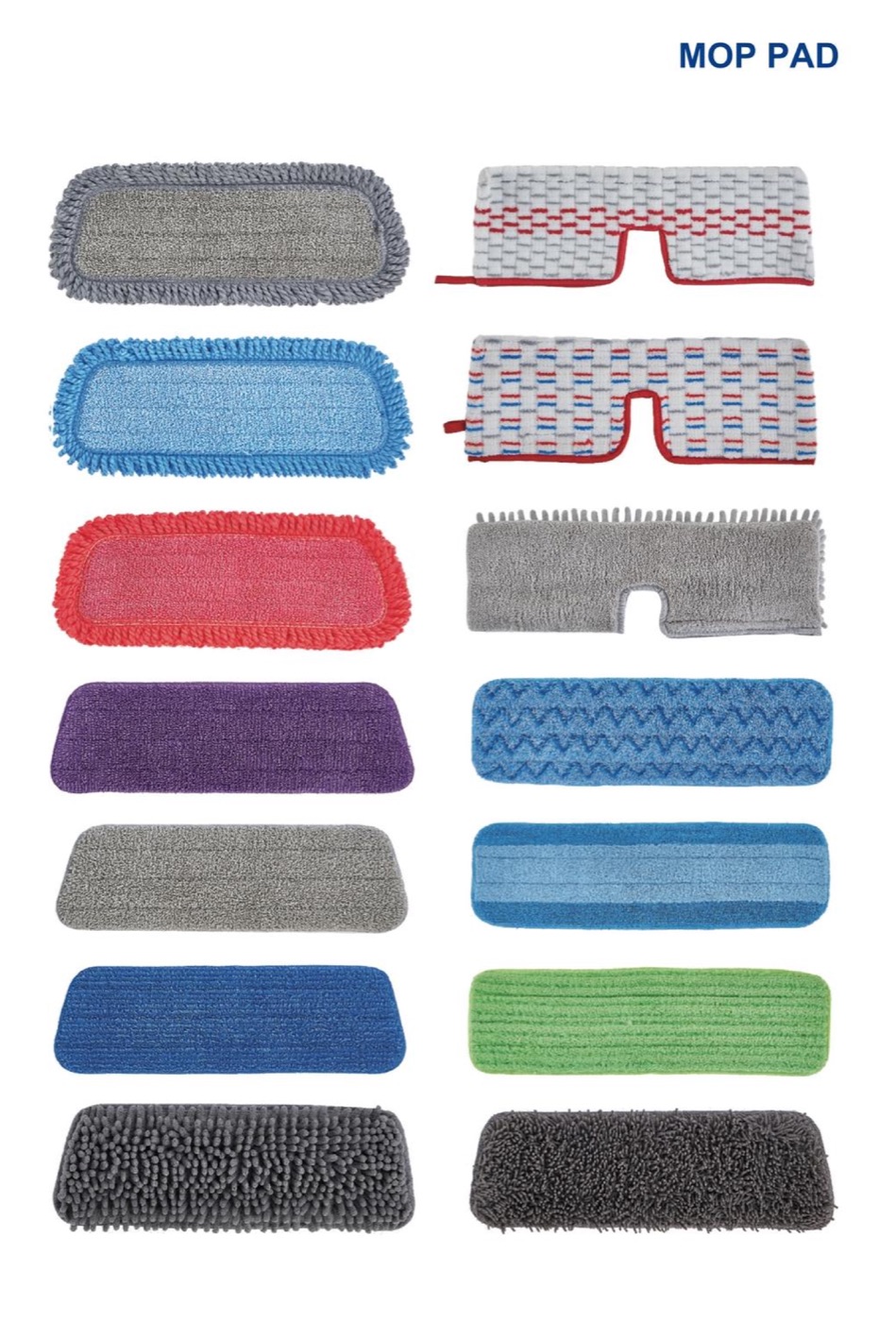
Which washable mop-pad options can be specified?
Common options include microfiber, chenille and tassel-style pads, with standard head references of 39.5 × 12 cm, 41.5 × 14 cm and 24.5 × 14.5 cm. A customer can also provide a sample or drawing for a different construction, size or attachment.
For the measured constructions, attachment types and replacement-pad MOQ, see the replacement-pad specification page.
How do I match a replacement pad to an existing mop head?
Match the physical head, not only a product name or photograph. Send the bare frame or a measured drawing, the existing pad, the attachment detail and the intended use. We then confirm the fit on a sample before production, so a visually similar pad is not treated as proof of compatibility.
| What to send | Why it matters |
|---|---|
| Head or measured drawing | Confirms length, width and the actual retention points |
| Existing pad or clear backing photo | Confirms the attachment and edge construction |
| Use and wash expectation | Sets the construction and repeat-use check |
| Retail pack requirement | Sets pad count, artwork, label and carton plan |
Can I order disposable mop pads or floor wipes separately?
Yes. Quote requests can cover disposable replacement pads or floor wipes on their own. For model-specific refills, specify the exact head. For wipes, send the dimensions and whether you need a dry or pre-moistened format, along with the pack count and destination market.
- Disposable mop pad fitted to Swiffer PowerMop
- SMN1000 auto-clip flat mop for disposable wipes
- SM1026 spray mop with a project-selected head and pad
Why is a replacement-pad programme worth a shelf position?
A mop is bought once; the pad is the part that is washed, worn and replaced. That is the commercial reason a refill programme exists at all: the mop wins the first order, the pad carries the repeat orders, and the pad can ship on its own with no mop attached to the shipment. One fabric run, dyed six ways, becomes six separate shelf positions.
The pad is the only part that wears out
A spray mop is a bottle, a pole, a trigger and a head — all of them last for years. The textile face is the only component the consumer throws away, which is why a refill is a stocked line item in a supermarket aisle rather than an accessory. A buyer who already sells our mop platform can add the pad range to the same container without opening a second supplier.
One fabric, six shelf positions
We stock six zone colours — blue, grey, red, green, yellow and purple. Colour is decided at the dye bath, so a single fabric construction can be sold as six SKUs, each with its own barcode and its own slot. The cutting, sewing and binding operation is identical across all six, so the second colour costs a dye lot, not a new programme.
Where the range actually branches
Three levers, in the order buyers usually pull them: face (microfibre, terry, chenille, tassel — different price points on the same head), colour (six zone codes, one fabric), and pack (single hang card, multi-pack polybag, or pad-plus-plate assembly). Each lever moves without touching the other two, which is what makes a small range look like a full one on the shelf.
How do we build a pad range without opening six moulds?
Start from the head you already sell, then branch on the face, the colour and the pack — none of which needs a new mould. A pad is cut and sewn fabric; the only tooling in the programme is the cutting die and the hang-card artwork.
Step 1 — fix the head and the attachment
Everything else follows the head: the pad outline, where the slot or the hook-and-loop face sits, and how the consumer takes it off. Send the bare frame or a measured drawing and we confirm the retention points before any fabric is cut.
Step 2 — choose how many faces
One face is enough to start. A second face (terry under microfibre, or chenille above it) gives a good/better pair on the same shelf slot with no new die. Most ranges we run settle at two or three faces.
Step 3 — multiply by colour, not by programme
Six zone colours are stocked. Two faces × three colours is six SKUs from two cutting operations; the same six SKUs by colour alone is one operation. Decide the grid before the first order, because the barcode and carton plan follow it.
| Lever | What changes | What it costs | SKUs it adds |
|---|---|---|---|
| Face / construction | Fabric and price point | A fabric line, same die | × number of faces |
| Colour | Dye bath and binding colour | A dye lot, same operation | × number of colours |
| Pack | Hang card, polybag or plate assembly | Artwork and a carton spec | × number of packs |
| Size | Cutting die | A new die | The only lever that needs tooling |
Measured constructions, attachment types and the tolerances we inspect against are on the replacement-pad specification page; this page is about building the range around them.
What does a standalone pad order need before we can quote?
Five fields and no call: pad length × width in millimetres, fabric construction and target weight, attachment type with a photo of the back of the head, colour or colour-code plan, and packing. MOQ is 3,000 pieces per pad type, lead time follows the standard 35-day term, and a counter-sample goes out before the bulk order.
MOQ and how it is counted
3,000 pieces per pad type — not per colour and not per order. A type is a combination of construction, size and attachment; colour variants inside one type do not each carry their own 3,000. Trial quantities below that are considered case by case for qualified buyers, usually inside a pad-plus-mop mixed order.
Packing, in the order it is decided
Pad count per pack first, then hang card or polybag, then artwork, label, barcode and carton. A shelf-ready hang card needs your artwork and a hook-slot position; a bulk polybag needs a carton count and a polybag print. The pad-plus-plate assembly is quoted with the plate, because the two are packed as one item.
Sampling and lead time
A physical sample is better than any drawing: we reverse-engineer the fabric and the stitching and send a counter-sample before you commit. Bulk runs on the standard 35-day term from order to shipment, FOB Ningbo or Shanghai; a new pad shape or a new colour waits for the next production slot rather than a new line.
| Stage | What happens | What we need from you |
|---|---|---|
| 1. Fit | Head and retention points confirmed | Bare frame, measured drawing, or photo of the back of the head |
| 2. Counter-sample | Fabric, weight, stitch and attachment matched | The existing pad, or a target weight in grams |
| 3. Approval | Colour, pack and barcode locked | Artwork, label copy, pack count |
| 4. Bulk | Production and inspection | Purchase order and shipping marks |
We already buy spray mops from you — how does a pad order attach to that?
It rides in the same container. The pad uses the head dimensions we already hold for your mop, so there is no new fit check, and the refill can be packed separately or as a pad-plus-mop kit. That is the cheapest way to test a refill range: one container, two SKUs, the mop that already sells and the pad that repeats.
Why the second SKU is cheap to add
The expensive part of a pad programme is the fit — confirming the head, the retention points and the finished size. On an existing mop order that work is already done, so the pad enters as a colour, pack and quantity decision rather than an engineering one.
Two ways to pack the first test
Separate refill SKU — the pad ships on its own hang card with its own barcode, priced and slotted as a refill. This is the version that produces repeat orders. Pad-plus-mop kit — one extra pad in the mop carton, sold as a value pack. This tests whether the market re-orders a pad at all before you commit to a refill barcode.
What to decide before the container
Whether the pad carries its own barcode, how many pads per pack, and whether the colour plan matches the mop already on shelf. Get those three wrong and the refill competes with the mop carton instead of extending it.
See SM1026 custom-head spray mop →
FAQ
Can I buy mop pads or disposable floor wipes without ordering mops?
Yes. For a replacement pad, send the head or pad dimensions and attachment. For floor wipes, specify the dimensions and dry or pre-moistened format. Include pieces per pack, order quantity and destination country so we can quote the requested configuration.
Do washable replacement pads fit every mop?
No universal fit is claimed. The head dimensions and attachment must be checked against the actual sample before production.
Can the pad use my own retail packaging?
Yes. Provide the required pad count, artwork, label, barcode and carton requirement. The final pack is confirmed alongside the approved pad sample.
Does each colour of pad carry its own MOQ?
No. The 3,000-piece MOQ is counted per pad type — a combination of construction, size and attachment. Colour variants inside one type are counted together, so a six-colour range does not need six minimum orders.
Can you send a sample before we place a pad order?
Yes. Send the existing pad, the bare frame or a measured drawing and we produce a counter-sample that matches the fabric, weight, edge stitch and attachment. The counter-sample is approved before bulk production starts.
How does a pad order ship with an existing mop order?
In the same container. The head dimensions are already on file from the mop order, so the pad enters as a colour, pack and quantity decision. It can ship as a separate refill SKU with its own barcode, or as a pad-plus-mop value pack inside the mop carton.